
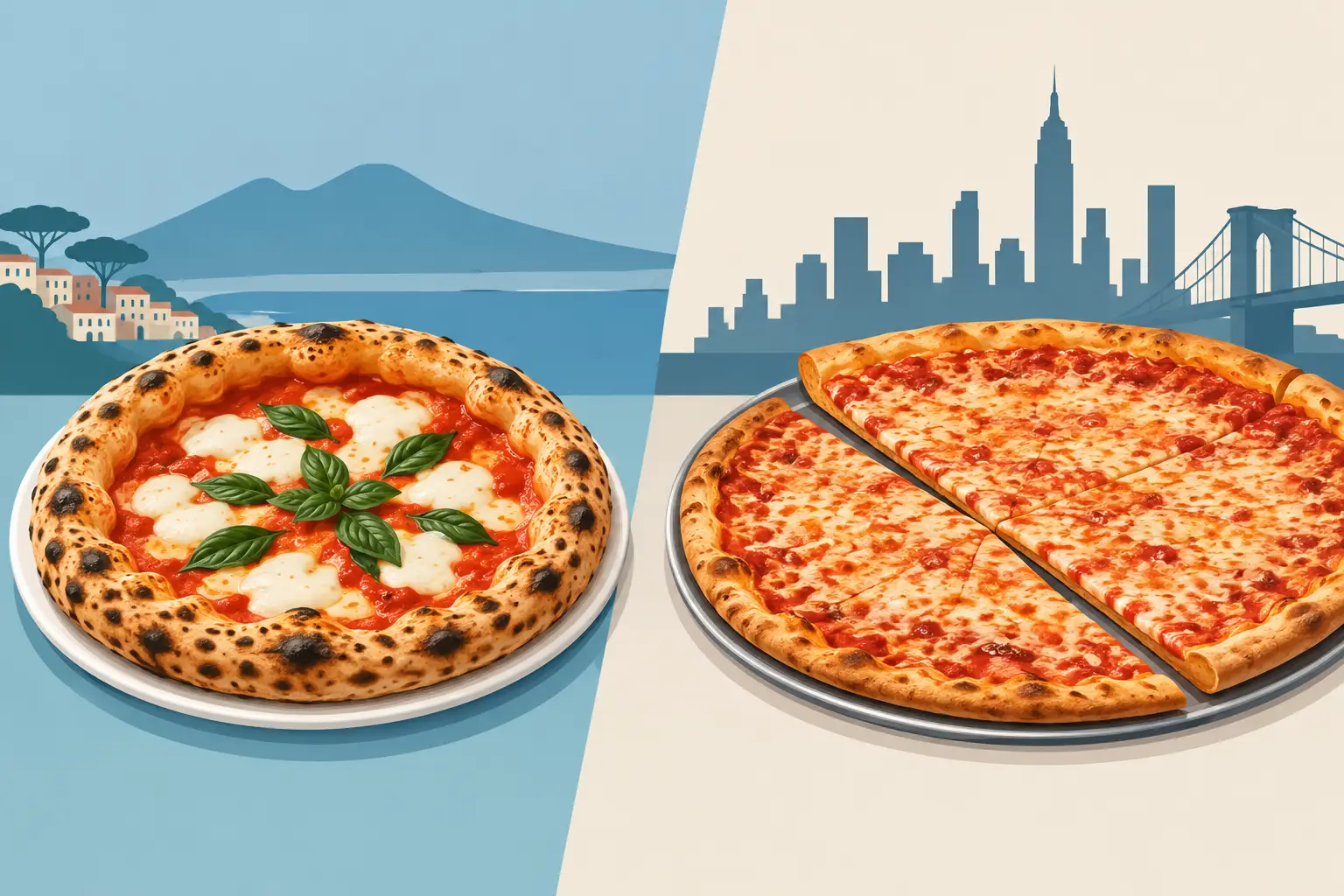
A pizza can be folded on a sidewalk corner or eaten with a knife and fork at a table, but those are not merely different habits. In the conversation around Neapolitan versus New York pizza, the real distinction begins long before the first bite: in the flour, the fermentation, the oven, and the tradition each style was built to honor.
Both pizzas have deep roots in New York’s food culture. Both can deliver a memorable balance of crust, tomato, cheese, and heat. Yet they ask for different things from the pizzaiolo and offer different pleasures to the guest. One is an exacting expression of Naples, served moments after leaving a fiercely hot oven. The other is a larger, sturdier New York classic designed for an energetic city that eats on the move.
Neapolitan Versus New York Pizza: The Essential Difference
Neapolitan pizza is a protected culinary tradition shaped in Naples. Its identity depends on precise technique: a naturally leavened dough, carefully selected ingredients, hand-stretching, and a blistering bake in a very hot oven. The finished pizza is typically small, soft at the center, airy at the edge, and best enjoyed immediately.
New York pizza evolved from Italian-American pizzerias adapting that heritage to a different city, different ovens, and a different pace of dining. It is usually wider in diameter, firmer beneath the toppings, and built to be sold by the slice. Its crust has enough structure to fold, making it practical to eat standing up, walking, or between meetings.
Neither style is a lesser version of the other. They are distinct answers to the same beautiful question: how can flour, water, tomatoes, cheese, and fire become greater together?
The Dough Tells the First Story
The character of a pizza starts with its dough. Traditional Neapolitan dough uses a short list of ingredients – flour, water, salt, and yeast – but the simplicity demands discipline. Hydration, fermentation time, room temperature, mixing, and handling all influence the final texture.
A well-made Neapolitan dough is often long naturally fermented. That patient process develops flavor and creates a dough that can expand dramatically in the oven. The cornicione, or raised outer rim, should be light and tender, with irregular air pockets and the gentle chew of properly developed gluten. It is not meant to be cracker-crisp.
New York dough generally contains similar foundational ingredients, though recipes often include oil and sometimes sugar. Those additions can contribute tenderness, browning, and flexibility. The dough is usually cold-fermented, then baked at a lower temperature for longer than Neapolitan pizza. The result is a crust with a crisp underside, a chewy interior, and more structural strength across a large slice.
This is why a New York slice can carry a generous layer of cheese and remain easy to fold. A Neapolitan pizza, by contrast, is intentionally more delicate. Its center may be soft enough that a knife and fork is the most graceful way to begin.
Fermentation Is Flavor, Not a Shortcut
Long fermentation is sometimes discussed as a technical detail, but guests taste its impact. It contributes complexity, aroma, and a lighter-feeling crust. It also gives the pizzaiolo a dough with the elasticity needed to open by hand without a rolling pin.
At Kesté, that respect for fermentation is part of the daily craft. The goal is not merely a dramatic, puffed edge. It is a crust with balance: fragrant, tender, and sturdy enough to frame ingredients without overwhelming them.
Heat Changes Everything
The oven is where the split between these two pizza styles becomes unmistakable.
Neapolitan pizza is baked at extremely high heat, traditionally in a wood-fired oven. It cooks in roughly 60 to 90 seconds. That short, intense bake creates leopard-spotted char on the crust, a rapid lift in the rim, and a soft center that preserves the brightness of the tomatoes and the milky freshness of mozzarella.
Timing matters down to seconds. Leave it in too long, and the delicate dough can become dry or bitter. Remove it too early, and the crust lacks the color and structure that define the style. The pizzaiolo must turn the pie with attention and read the oven’s living heat.
New York pizza bakes at a comparatively lower temperature, often in a deck oven, for several minutes. That longer bake dries the base further and renders the cheese more fully. The texture becomes crisper, more uniform, and more durable. It is a practical achievement as much as a delicious one: a New York pie needs to perform slice by slice, even after a brief reheat.
Toppings: Restraint Versus Abundance
Neapolitan pizza favors proportion. A Margherita may contain tomatoes, fresh mozzarella, basil, extra-virgin olive oil, and little else. This is not minimalism for its own sake. Each ingredient has room to speak, so quality becomes impossible to hide.
Tomatoes should taste bright and naturally sweet. Mozzarella should melt into soft pools rather than form a heavy blanket. Olive oil should bring aroma and richness, while basil adds a final green, peppery lift. When ingredients are this exposed, provenance and handling matter profoundly.
New York pizza is often more cheese-forward, with low-moisture mozzarella creating the familiar stretchy pull and browned surface. Its stronger base supports a broader range of toppings, from pepperoni and sausage to vegetables and specialty combinations. The style welcomes abundance, provided the slice remains balanced and foldable.
There is a trade-off here. A loaded New York slice can be deeply satisfying and wonderfully substantial. A Neapolitan pizza offers greater clarity, where the dough, sauce, and cheese remain in active conversation rather than competing for attention.
How Each Pizza Should Feel to Eat
The ideal Neapolitan pizza arrives hot, fragrant, and fleeting. Its crust is crisp at the first touch, then soft and yielding toward the center. The rim may show dark blisters from the oven, while the middle holds moisture from the sauce and cheese. It is at its peak the moment it reaches the table.
That immediacy is part of its charm. Neapolitan pizza is not designed to wait under a heat lamp, travel across town for an hour, or maintain the same texture the next day. It is a restaurant experience, a product of fire and timing.
New York pizza is more forgiving. The edge has a crackle, the center bends without collapsing, and the slice stays cohesive in the hand. It travels well, reheats well, and makes sense as a fast lunch, a late-night meal, or a shared office order.
For diners, the question is less about which style is objectively better and more about what the moment calls for. Want a composed meal centered on craft, exceptional ingredients, and the theater of the oven? Choose Neapolitan. Want a large, crisp-edged slice you can fold and eat on the move? New York pizza is hard to beat.
What About Gluten-Free Pizza?
This comparison becomes more meaningful when every guest can participate fully. Gluten-free diners should not have to settle for a dry, generic crust while everyone else enjoys an artisanal pizza experience.
Creating a gluten-free Neapolitan-style pizza requires dedicated knowledge and serious safety standards. The dough must deliver tenderness, lift, and flavor without wheat gluten, while preparation must protect guests with celiac disease or serious gluten sensitivities from cross-contact. A separate certified production environment and careful handling are not extras. They are the foundation of trust.
When made with the same respect given to traditional dough, gluten-free pizza can offer a complete, celebratory meal for mixed groups. That is hospitality in its most meaningful form: everyone at the table gets a pizza worth remembering.
Choose the Slice That Fits the Moment
Choose New York pizza when you want familiar comfort, a crisp fold, and the satisfying ease of a classic city slice. Choose Neapolitan pizza when you want to slow down for a few minutes and taste what precision can do with elemental ingredients.
The best approach is not to declare a winner. Order with curiosity, eat the pizza while it is at its best, and let the crust tell you where it came from.