
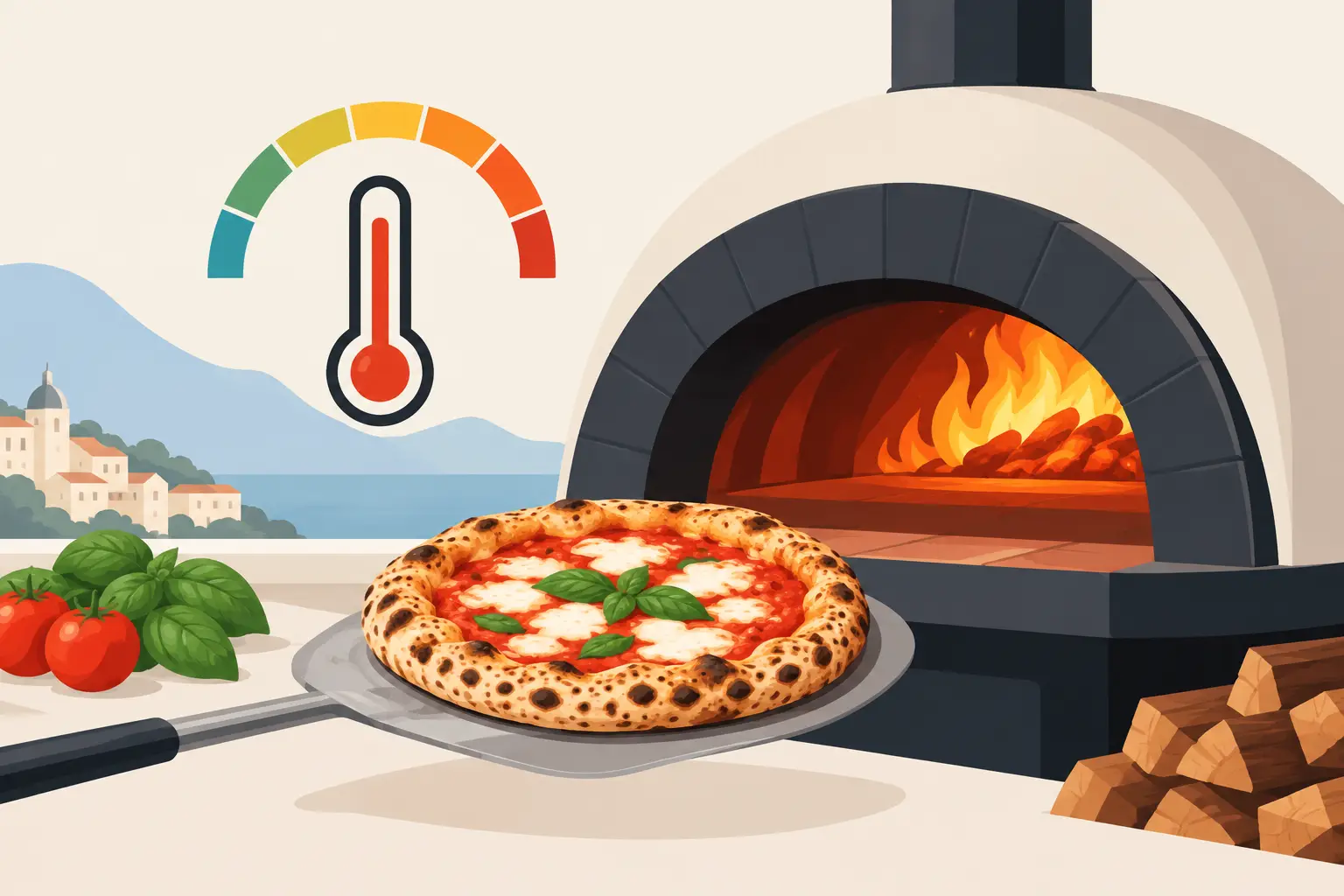
A true Neapolitan pizza does not slowly bake until it is dry. It meets intense heat, rises at the edge, sets at the center, and comes out in roughly 60 to 90 seconds. That is why Neapolitan pizza oven temperatures are not a minor technical detail. They are the condition that gives the pizza its soft, airy cornicione, tender center, leopard-spotted char, and unmistakable aroma.
At Kesté, the work begins long before the pizza enters the oven: with naturally fermented dough, carefully chosen Italian ingredients, and the practiced hands that shape each round. But the oven is where those preparations become pizza. Heat must be powerful, controlled, and understood.
The Traditional Neapolitan Temperature Range
For a classic Neapolitan bake, the oven floor should generally sit around 800°F to 850°F, while the dome and upper chamber may reach 900°F to 950°F or more. The traditional benchmark often cited for Neapolitan pizza is about 905°F. At this level of heat, the dough cooks before its moisture has time to disappear.
The floor heat sets the underside of the pizza. The radiant heat from the dome cooks the top, melts the cheese, and gives the rim its characteristic blistering. Both matter. A hot floor with weak top heat can leave a pale, undercooked rim; excessive top heat over a cooler floor can burn the cornicione before the center has properly set.
This is also why a pizza oven thermometer is useful but incomplete. A thermometer mounted high in the oven may reflect the air or dome temperature, not the exact condition of the cooking surface. An infrared thermometer aimed at the oven floor gives a more practical reading before launching the pizza.
Why High Heat Creates a Different Pizza
Neapolitan pizza is built around speed. The dough is typically soft, hydrated, and handled gently so it can expand in the oven. When it hits a properly heated floor, water in the dough turns to steam almost immediately. That rapid expansion creates the open, delicate structure inside the cornicione.
At the same time, the exterior begins to brown through caramelization and the Maillard reaction. The goal is not an evenly dark, cracker-like crust. It is a tender crust with pockets of char, a lightly crisp base, and enough flexibility to fold naturally at the tip.
Cheese and tomatoes benefit from this short bake, too. Fresh mozzarella softens and releases some moisture without turning rubbery. Tomatoes warm, sweeten, and concentrate while retaining their brightness. In a lower-temperature oven with a longer bake, the same ingredients can lose their freshness, and the dough can dry out before the top is finished.
There is a trade-off. Very high heat is unforgiving. A few seconds too long can take a beautifully blistered edge to a burnt one, particularly if flour has accumulated beneath the pizza or if the fire is aggressively rolling across the dome.
Reading the Oven, Not Just the Number
A skilled pizzaiolo does not rely on one number alone. The oven needs to be read as a living environment. The flame position, strength of the live fire, heat of the floor, and recovery time between pizzas all affect the result.
Before a service rush, an oven may show an ideal floor temperature. After several pizzas, however, the floor can cool faster than the dome. A pizza may still brown beautifully on top while the bottom needs extra time, creating a softer or less balanced crust. Conversely, if the floor is overheated, the base can blacken before the rim has fully expanded.
The visual signs are useful. A properly heated oven produces a pizza that begins to puff quickly after launch. The rim should rise before the cheese overcooks. As the pizza turns, small dark spots develop across the cornicione rather than one large scorched area. The bottom should have color and structure without a bitter, burned flavor.
In a wood-fired oven, the fire should be active and positioned to one side. This creates the intense radiant heat that distinguishes this style of baking. The pizza is launched away from the flame, then rotated frequently as it cooks. There is no set-it-and-forget-it moment in a 90-second bake.
Neapolitan Pizza Oven Temperatures at Home
Most home cooks do not have a restaurant wood-fired oven, and that does not mean they cannot make excellent pizza. It does mean expectations and technique should adjust to the equipment.
A dedicated outdoor pizza oven that reaches 750°F to 900°F can produce a close approximation of a traditional Neapolitan result. Preheat it fully, not just until the flame looks impressive. The stone or baking floor needs time to absorb heat. Depending on the oven, that may take 20 to 40 minutes after ignition.
For a pizza baked around 800°F, start checking it after 60 seconds and turn it every 15 to 20 seconds. The exact timing depends on the oven’s flame pattern, the dough’s hydration, and the amount of topping. A Margherita with tomatoes and fresh mozzarella behaves differently from a lighter pizza with less surface moisture.
A standard indoor home oven is a different situation. Even at 500°F or 550°F, it can make a delicious artisanal pizza, but the bake will take several minutes rather than one. Use a preheated baking steel or stone, position it near the upper heat source, and finish under the broiler if needed. The crust will be more New York-adjacent or home-oven adapted than strictly Neapolitan, and that is a worthwhile distinction rather than a failure.
Trying to force a 90-second method in an oven that cannot sustain the required heat often leads to an underbaked center or a scorched cheese layer. Let the oven determine the method.
Dough, Toppings, and Temperature Must Work Together
Oven heat cannot rescue a dough that has not fermented properly or toppings applied without restraint. Neapolitan pizza needs balance at every stage.
A long-fermented dough develops flavor and extensibility, allowing it to stretch without tearing and puff under high heat. Too much bench flour can burn on the floor and taste bitter. Too much sauce, mozzarella, or watery topping can cool the center and prevent it from setting during the brief bake.
Keep toppings intentional. Use crushed tomatoes with a clean, balanced texture, drain fresh mozzarella as needed, and avoid piling ingredients into the center. The pizza should cook as one composition, not as dough carrying a heavy casserole.
Gluten-free Neapolitan-style pizza requires equal attention, with adjustments for its dough structure and handling. A dedicated gluten-free preparation environment is essential for guests with celiac-related needs, while the bake must still preserve a crisp base, tender interior, and properly cooked toppings. Inclusion should never mean accepting a lesser pizza.
Common Temperature Problems and Their Meaning
If the bottom burns while the top remains pale, the floor is likely too hot relative to the dome, or the pizza has picked up excess flour. Give the floor time to settle, brush away burned residue, and build a stronger live flame before the next launch.
If the cheese is cooked but the base is pale and soft, the floor is too cool. Continue heating until the cooking surface recovers. This is especially common after back-to-back pizzas, when the dome still looks hot but the floor has lost energy.
If the rim colors too quickly while the center is wet, the pizza may be too heavily topped, the dough may be too thick in the middle, or the oven’s top heat may be too aggressive. Stretch evenly and use less moisture. A pizza is not improved by more ingredients than the dough can support.
If the crust is dry, tough, or cracker-like, the oven may be too cool for the dough formula, causing an overly long bake. It can also indicate overworked dough or insufficient fermentation. Heat matters, but it is only one part of the craft.
The most memorable Neapolitan pizza is not defined by a thermometer reading alone. It is defined by the moment when fermentation, ingredient quality, shaping, flame, and attention meet. When the pizza leaves the oven with a risen rim, a fragrant center, and just the right touch of char, the temperature has done what it was meant to do: let the dough speak.